If you've ever searched "What is my home worth?" you've likely seen an automated home value estimate from websites like Zillow, Realtor.com, Redfin, or Homebot. While these tools can provide a general estimate, they often fail to capture the factors that truly determine a home's market value.
Understanding the limitations of automated home valuations can help homeowners make better decisions when buying, selling, refinancing, or planning for the future.
How Accurate Are Automated Home Valuations?
Automated home valuations are best used as a starting point rather than a definitive value.
Most online home value estimates rely on algorithms that analyze public records, tax data, recent sales, and property characteristics. While these systems can process large amounts of information quickly, they cannot physically inspect a property or evaluate many of the factors that influence a home's true market value.
In some cases, automated valuations may be reasonably close. In others, they can be off by tens of thousands of dollars or more.
Why Are Online Home Value Estimates Often Wrong?
The biggest reason automated home valuations are inaccurate is that they cannot see the home's condition, updates, or unique features.
Algorithms cannot determine:
Whether a kitchen was recently renovated
The quality of bathroom upgrades
The condition of the roof or HVAC system
Interior design and finishes
Curb appeal
Deferred maintenance
Water views or premium lot locations
Local buyer demand
These factors often play a significant role in determining what buyers are willing to pay.
What Information Do Automated Valuations Use?
Most automated valuation models (AVMs) use:
Public tax records
Previous sales history
Property size
Number of bedrooms and bathrooms
Lot dimensions
Nearby home sales
Market trends
However, public records are not always accurate. Incorrect square footage, missing permits, outdated property information, and data entry errors can all impact the estimated value.
Can Zillow, Homebot, and Other Home Value Websites Be Wrong?
Yes.
Different websites often provide different estimates for the same property because each company uses its own proprietary algorithm and data sources.
Homeowners frequently notice significant differences between estimates on Zillow, Realtor.com, Redfin, Homebot, and other valuation platforms.
If multiple websites provide different values for the same home, it highlights the limitations of automated valuation technology.
Why Do Similar Homes Have Different Values?
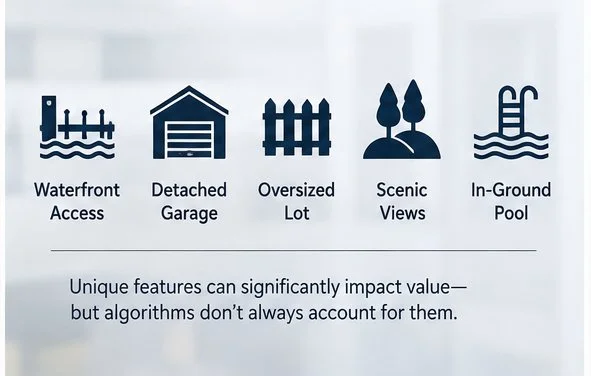
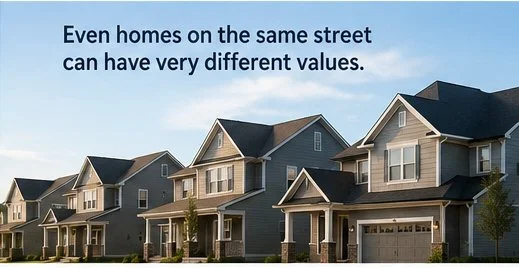
Two homes may appear similar on paper but have dramatically different market values.
Factors that can impact value include:
Condition and maintenance
Renovations and upgrades
Lot size
Water views
Privacy
Cul-de-sac location
School district demand
Outdoor living spaces
Pools and docks
Finished basements
Detached garages
Automated systems often struggle to accurately account for these differences.
Are Automated Home Valuations Accurate for Waterfront Homes?
Waterfront properties are among the most difficult homes for algorithms to value.
In coastal communities throughout Ocean County and Long Beach Island, factors such as water access, views, dockage, flood zones, bulkheads, and location can create substantial differences in value between seemingly similar properties.
Because these homes are often unique, automated estimates are typically less reliable.
What Is More Accurate Than an Automated Home Valuation?
A Comparative Market Analysis (CMA) prepared by a local real estate professional is generally more accurate than an automated valuation.
A CMA considers:
Recent comparable sales
Current market conditions
Property condition
Renovations and upgrades
Neighborhood trends
Buyer demand
Unique property features
Unlike an algorithm, a real estate professional can physically evaluate the property and understand local market dynamics.
How Can I Find Out What My Home Is Really Worth?
The most accurate way to determine your home's value is to request a professional Comparative Market Analysis.
A local real estate expert can review your home's features, condition, location, and recent comparable sales to provide a realistic estimate of what buyers may be willing to pay in today's market.
While online estimates can offer a general range, a personalized CMA provides a much clearer picture of your home's true market value.
Frequently Asked Questions
Is Zillow's Zestimate accurate?
Zestimates can provide a useful starting point, but they do not account for condition, upgrades, or many local market factors that influence value.
Why is my Zillow estimate different from my Realtor's estimate?
A Realtor evaluates the property's condition, features, and local market activity, while Zillow relies primarily on algorithms and public data.
What is the most accurate way to determine home value?
A professional Comparative Market Analysis (CMA) performed by a local real estate professional is typically the most accurate method.
Do home improvements increase online home estimates?
Not always. Many renovations and upgrades are not immediately reflected in public records, meaning automated systems may not recognize them.
The Bottom Line
Automated home valuations can be useful tools, but they should never be viewed as an exact measure of value. Real estate is highly local, and factors such as condition, updates, location, views, and buyer demand can dramatically impact what a home is worth.
If you're curious about your home's value in today's market, a professional Comparative Market Analysis provides a more complete and accurate assessment than any automated estimate.
Looking for an accurate home value estimate in Ocean County or the Long Beach Island region? Contact Lisa G. Lopez for a complimentary Comparative Market Analysis tailored to your property and local market conditions.